

When routes become risk, resilience depends on how quickly signals become decisions.
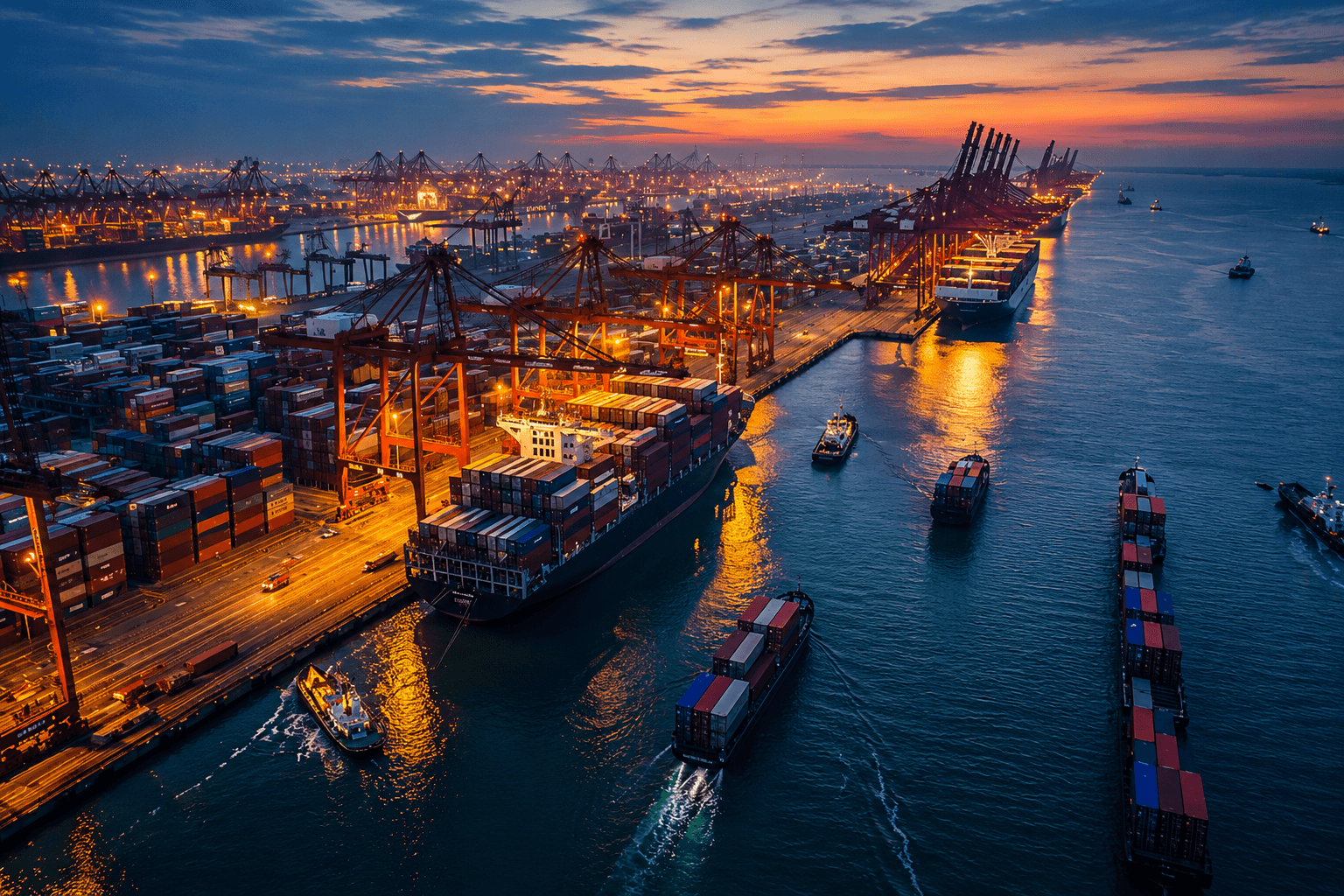
At dusk, a port looks ordered: cranes lit in sequence, containers stacked in grids, vessels moving through defined lanes. The reality behind that order is more fragile. The Strait of Hormuz is again being discussed as a pressure point for trade, energy, insurance, routing, and regional security.
As of 5 August 2026, recent reporting describes negotiations around an interim Iran-Oman route arrangement, while maritime authorities continue to warn that risks to commercial shipping in the Persian Gulf, Strait of Hormuz, and Gulf of Oman remain elevated. That combination matters: diplomacy may move, but operating risk does not disappear at the speed of a headline.
For Microcorem, the lesson is not only geopolitical. It is operational. Businesses need systems that show exposure quickly: which suppliers depend on which lanes, which customer promises depend on which lead times, which contracts carry escalation risk, and which teams need a decision before delay becomes failure.
Route risk is now a data problem
Maritime disruption used to sit mainly with logistics specialists. Now it touches finance, customer service, procurement, content, and leadership. A blocked or volatile route can change delivery windows, stock positions, energy assumptions, campaign timing, and customer messaging in the same week.
Microcorem helps teams model these dependencies as living operational data, not as a spreadsheet updated after the problem has already moved. That means joining route intelligence, supplier data, inventory, finance, and customer commitments into one usable view.
What calm systems do during uncertainty
A calm system does not pretend to predict every political decision. It makes uncertainty actionable. It gives operators scenarios, thresholds, ownership, and escalation paths so the business can respond without improvising from disconnected reports.
In practice, that can mean shipment-risk dashboards, supplier dependency maps, AI-assisted exception triage, customer communication workflows, and executive views that separate noise from decisions that need attention today.
The Microcorem takeaway
The harbour image is full of light, but the useful signal is coordination. Ports work because timing, assets, people, and rules are synchronised. Modern companies need the same discipline when external conditions become volatile.
Hormuz is a reminder that resilience is not a slogan. It is architecture: connected data, clear workflows, responsible automation, and decision surfaces that help teams act before uncertainty becomes customer pain.